Showing posts with label Breast Cancer Surgeon in India. Show all posts

Thursday, 11 May 2017

Breast Cancer Treatment in India

Breast Cancer Treatment in India

General Information About Breast Cancer


Key Points about Breast cancer

  • Breast cancer is a disease in which malignant (cancer) cells form in the tissues of the breast.
  • A family history of breast cancer and other factors increase the risk of breast cancer.
  • Breast cancer is sometimes caused by inherited gene mutations (changes).
  • The use of certain medicines and other factors decrease the risk of breast cancer.
  • Signs of breast cancer include a lump or change in the breast.
  • Tests that examine the breasts are used to detect (find) and diagnose breast cancer.
  • If cancer is found, tests are done to study the cancer cells.
  • Certain factors affect prognosis (chance of recovery) and treatment options.

Breast cancer is a disease in which malignant (cancer) cells form in the tissues of the breast.

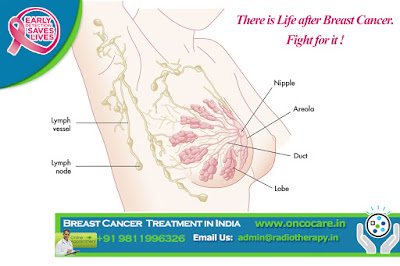
The breast is made up of lobes and ducts. Each breast has 15 to 20 sections called lobes. Each lobe has many smaller sections called lobules. Lobules end in dozens of tiny bulbs that can make milk. The lobes, lobules, and bulbs are linked by thin tubes called ducts.
Top Breast Cancer Treatment in India

Anatomy of the female breast. The nipple and areola are shown on the outside of the breast. The lymph nodes, lobes, lobules, ducts, and other parts of the inside of the breast are also shown.
Breast Cancer Treatment in India

Each breast also has blood vessels and lymph vessels. The lymph vessels carry an almost colorless fluid called lymph. Lymph vessels carry lymph between lymph nodes. Lymph nodes are small bean-shaped structures that are found throughout the body. They filter substances in lymph and help fight infection and disease. Clusters of lymph nodes are found near the breast in the axilla (under the arm), above the collarbone, and in the chest.
The most common type of breast cancer is ductal carcinoma, which begins in the cells of the ducts. Cancer that begins in the lobes or lobules is called lobular carcinoma and is more often found in both breasts than are other types of breast cancer. Inflammatory breast cancer is an uncommon type of breast cancer in which the breast is warm, red, and swollen.
following PDQ summaries for more information about breast cancer:

Monday, 1 May 2017

Breast Cancer Treatment in India

Breast Cancer Treatment in India


Breast Cancer


Radiation therapy is the use of high-energy x-rays or other particles to kill Breast Cancer cells. A doctor who specializes in giving radiation therapy to treat cancer is called a Radiation Oncologist in India. The most common type of radiation treatment is called external-beam radiation therapy, which is radiation given from a machine outside the body. When radiation treatment is given using a probe in the operating room, it is called intraoperative radiation. When radiation is given by placing radioactive sources into the tumor, it is called brachytherapy. Although the research results are encouraging, intra-operative radiation and brachytherapy are not widely used, and treatment is typically reserved for a small cancer with no evidence that it has spread to the lymph nodes.
radiation therapy regimen usually consists of a specific number of treatments given over a set period of time. Most commonly, radiation therapy is given after a lumpectomy, and following adjuvant chemotherapy if recommended. Radiation therapy is usually given daily for a set number of weeks to get rid of any remaining cancer cells near the tumor site or elsewhere in the breast. This helps lower the risk of recurrence in the breast. In fact, with modern surgery and radiation therapy, recurrence rates in the breast are now less than 5% in the 10 years after treatment, and survival is the same with lumpectomy or mastectomy.
Adjuvant radiation therapy may also recommended for some women after a mastectomy, depending on the age of the patient, the size of their tumor, the number of lymph nodes under the arm that contain cancer, the width of healthy tissue around the tumor removed by the surgeon, the ER, PR, and HER2 status, and other factors.
Neoadjuvant radiation therapy is radiation therapy given before surgery to shrink a large tumor, which makes it easier to remove. 
Radiation therapy can cause side effects, including fatigue, swelling of the breast, redness and/or skin discoloration/hyperpigmentation and pain/burning in the skin where the radiation was directed, sometimes with blistering or peeling. Very rarely, a small amount of the lung can be affected by the radiation, causing pneumonitis, a radiation-related swelling of the lung tissue. This risk depends on the size of the area that received radiation therapy, and this tends to heal with time. In the past, with older equipment and radiation therapy techniques, women who received Best Breast Cancer treatment in India on the left side of the body had a small increase in the long-term risk of heart disease. Modern techniques are now able to spare most of the heart from the effects of radiation.
Call Us For Appointment Best Oncologist in India +91 9811996326 

Friday, 28 April 2017

Best Radiation Oncologist in India

Best Radiation Oncologist in India


oncologist in india


Radiation therapy uses high-energy radiation to shrink or eradicate tumor cells. Radiation therapy kills cancer cells by damaging their DNA, and cancer cells whose DNA is damaged beyond repair stop dividing or die.  There are a variety of types of radiation used for cancer treatments. The radiation may come from a machine outside of the body (linear accelerator - LINAC), or it may come from radioactive material placed in the body (brachytherapy).

Patients may receive radiation therapy before, during or after surgery and/or chemotherapy, depending the on the type and site of cancer being treated.

Best Coordinator Oncology Specialist in India

Patients typically receive external-beam radiation therapy in daily treatment sessions over the course of several weeks.  The number of treatment sessions depends on many factors, including the total radiation dose that will de delivered.  Additional items the physician will consider are type and size of the cancer, location in the body, proximity of the tumor to normal tissues that are sensitive to radiation, patient’s general health and medical history and if the patient will have any other type of cancer treatment in india (e.g., Chemotherapy).
oncocare.in has numerous clinical locations, strategically located throughout our network, where patients can receive radiation therapy. Radiation therapy is an important weapon in our battle against cancer. Depending on the type and extent of cancer, radiation therapy can be used alone or in combination with other treatments, such as surgery or chemotherapy.

Radiation therapy effectively treats cancer by using high-energy beams of radiation to pinpoint and destroy cancerous cells. Although radiation therapy is similar to an x-ray, the dose of radiation in cancer treatment is much stronger and is given over a longer period of time.

Various forms of radiation therapy are available; the two basic types are external beam radiation and internal radiation, or brachytherapy.

If your physician determines that radiation therapy should be a part of your treatment plan, and it is not offered within the area where you receive other services, you will be referred to one of our strategic partners for treatment. Your physician will discuss whether radiation therapy is right for you.
Call Us for Appointment : +91 9811996326 
E-mail:  admin@radiotherapy.in  Visit for More Details: www.oncocare.in

Tuesday, 25 April 2017

Breast Cancer Treatment in india

Breast Cancer Treatment in India


 breast Cancer treatment in india


If you have breast cancer, your healthcare team will create a Breast Cancer Treatment in India plan just for you. It will be based on your health and specific information about the Breast Cancer. When deciding which treatments to offer for ductal carcinoma and lobular carcinoma, your healthcare team will consider:
  • the stage
  • if you have reached menopause
  • the hormone receptor status of the cancer
  • the HER2 status of the cancer
  • the risk that the cancer will come back, or recur (for early stage breast cancers)
  • your overall health
You may be offered one or more of the following treatments for breast cancer.

Breast Cancer Surgery in India

Most women with breast cancer will have surgery. Your healthcare team will talk to you about the different types of surgery to help you decide which is best for you. The types of surgery you will be offered depend mainly on:
  • the size and location of the tumour
  • the size of the breast
  • if the cancer has spread to the lymph nodes
  • if you have already had any treatments for breast cancer
Surgery for breast cancer includes breast-conserving surgery, mastectomy and lymph node surgeries.

Radiation therapy in India

External beam radiation therapy uses a machine to direct radiation through the skin to the tumour and tissue around it.
Radiation therapy is almost always given after breast-conserving Breast Cancer Surgery. In some cases it may be given after a mastectomy. It is also used to treat breast cancer that has spread to the bones, lungs or brain.

Hormonal therapy

Hormonal therapy is often used to treat hormone receptor–positive breast cancer. Post-menopausal women are given different hormonal therapy drugs than premenopausal women.

Chemotherapy

Chemotherapy is a common treatment for breast cancer. It is often given after surgery for early stage breast cancer to reduce the risk that the cancer will come back. It is also the main treatment for advanced or metastatic breast cancer.
Combinations of chemotherapy drugs are most often used for breast cancer because they are more effective than single drugs.

Targeted therapy

Targeted therapy may be given alone or in combination with chemotherapy, hormonal therapy or both.

Call us for Appointment : +91 9811996326 

Thursday, 13 April 2017

Breast Cancer Specialist in India

Breast Cancer Specialist in India

Breast Cancer Treatment in India

What to expect during external beam radiation therapy (EBRT)

Radiation treatment in India is usually started after enough time has gone by for your surgery wound to heal, often at least 2 to 3 weeks. EBRT is usually given once a day, 5 days a week, for a set number of weeks.  Or you may go to the radiation center twice a day and get a larger dose of radiation over a shorter period of time. You will need to go to the radiation clinic every day for treatment.

Radiation treatment is a lot like getting an X-ray, but the radiation is stronger. The radiation comes from a large machine. The machine doesn't touch you during the Breast Cancer Specialist in India. The treatments don't hurt and they are quick. The whole process will likely take less than an hour.

Things like lotion, powder, and deodorant can interfere with EBRT. You may be asked not to use them until after treatment.

On the day of treatment, you are carefully put into the right position. If you need to lie in an awkward position, the radiologist may make a mold of your body, which can be used to support you and keep you from moving during treatment. You may see lights from the machine lined up with the marks on your skin. These help the therapist know you are in the right position. The therapist will leave the room while the machine sends radiation to your tumor. During this time, he or she can see you, hear you, and talk to you. When the machine sends radiation to your tumor, you will need to be very still, but you do not have to hold your breath.

The radiation oncologist and the radiation therapist will carefully monitor the intensity and length of each radiation treatment. They will also check the area that is being treated. You will get regular physical exams and blood tests during the course of your treatments.

What to expect during internal radiation therapy

For internal radiation therapy, the radiation is directed from inside the body. The radiation therapist places small thin hollow tube called a catheter directly into the Breast Cancer where the tumor used to be. Radioactive seeds or pellets are then put into the catheter for short periods of time each day. They are then removed when the treatment is over. Internal radiation may be done along with or instead of EBRT.