Showing posts with label Breast Cancer Treatment In Delhi. Show all posts

Tuesday, 20 June 2017

Breast Cancer Treatment in Delhi

Breast Cancer Treatment in Delhi


A breast cancer treatment in delhi is life-altering, but rest assured: the experts at Presence Health are ready to treat—and beat—the disease. 

When you come to oncocare.in Cancer Centers for Care, you’ll find the Best Technologies, Expertise and Techniques used by Oncocare Specialist, but in your own backyard. Expert Doctor team will work with you every step of the way to find the best and greatest number of treatment options available, all in a comfortable and compassionate environment.


Breast cancer begins when a group of cancer cells forms a malignant tumor that invades surrounding breast tissue or spreads to other areas of the body. According to the American Cancer Society, one in eight women in the U.S. will develop invasive breast cancer during her lifetime.

Many breast lumps turn out to be non-cancerous. However, a malignant lump can mean that the cancer has already spread beyond the breast. Therefore, it is important to get regular cancer screenings, before you find a lump, so that your doctor can catch and treat any concerns before they progress.

Oncocare is one of the largest freestanding cancer clinics in the Delhi. We proudly provide the Best Breast Cancer Treatment in Delhi, treatment and clinical trials and the highest level of patient-focused care.
When you come to us for Breast Cancer Treatment in Delhi, you receive the same advanced technology and treatment methods of Oncocare Medical Company, but in one convenient location close to home. Dr. Kundan Singh Chufal is Experienced Oncologists deliver the specialized expertise you can trust and the personalized attention you deserve.
Call us for Appointment: +91 9811996326  or E-mail: admin@radiotherapy.in

Wednesday, 19 April 2017

Stages of Breast Cancer

Stages of Breast Cancer

Breast Cancer Treatment in Ncr

Breast cancer is classified by stages of development. The classification allows a better understanding of prognosis and treatment.

Early (zero) stage of breast cancer is considered as a state in which the atypical cells are localized in the breast tissue and there are no signs that they have spread to the lymph nodes.

Stage 1 of breast cancer: tumor size less than two centimeters (approximately an inch) and has not spread to surrounding lymph nodes or outside the breast.

Stage 2 breast cancer is divided into two groups: the size of the tumor and whether or not it has spread to the lymph nodes:


2A: tumor less than 2 cm in cross section with the spread to the lymph node, or tumor from 2 to 5 cm without the spread to auxiliary lymph nodes.

2B: tumor more than 5 cm in cross section (the result of auxiliary lymph nodes research is negative for cancer cells) or tumor from 2 to 5 cm in diameter with the involvement of auxiliary lymph nodes. Late (metastatic) stages of breast cancer occur when cancer cells spread to the lymph nodes and other tissues.

Stage 3 breast cancer is also divided in to two categories:

3A: tumor measures more than 5 cm with spread to auxiliary lymph nodes (local spread of breast cancer) or tumor of any size with metastases in auxiliary lymph nodes, which are weaved to each other or with the adjacent tissues.

3B: tumor (any size) with metastases into the skin, chest wall or internal lymph nodes of mammary gland (found below the breast inside of chest).

Stage 4 is defined by the spread of the cancer to other organs or tissues, such as the liver, lungs, brain, skeletal system, or lymph nodes near the collarbone.

Call Us For Appointment : +91 9811996326 

Breast Cancer Treatment in Delhi Ncr

Breast Cancer Treatment In Delhi


Breast Cancer Treatment in Ncr

The most common forms of breast cancers begin in the milk ducts, lobules or glands and are named accordingly. There are many types of breast cancer but a pathologist can identify the differences by observing sections of the tumor through a microscope. It is important to speak with your healthcare team as each Breast Cancer Treatment case is unique.


The term “in situ” or "in place" refers to a very early form of cancer that has not spread. DCIS is a type of pre-cancer inside of the ductal system that has not attacked the nearby tissue. Currently, there is no way to determine if this type of breast cancer will go on to become invasive. This is a very common type of non invasive cancer with 1 in 5 diagnosed as DCIS. Nearly all patients diagnosed with this type of pre-cancer can be cured. 

Mammography Test in Delhi , oncocare.in is Best Breast Cancer Treatment in Delhi

Lobular Carcinoma in Situ (LCIS)

This is a very rare non-invasive tumor that most doctors believe will not develop into invasive cancer. LCIS is more of a “marker” or signal that breast cancer may develop. Described as an abnormal growth in the number of cells, LCIS has recently been renamed lobular neoplasia. Women who have these “markers” are at greater risk of developing breast cancer later in life.
Top Breast Cancer Treatment in  Ncr


Infiltrating Ductal Carcinoma (IDC)

IDC is the most common type of breast cancer. It starts in the milk ducts of your breast and spreads to surrounding tissues. IDC could spread through the lymph system or bloodstream to other parts of your body. Approximately 8 out of 10 invasive breast cancers are IDC.


Medullary Carcinoma

Medullary carcinoma accounts for 15% of all breast cancer types. It most frequently occurs in women in their late 40s and 50s, presenting with cells that resemble the medulla (gray matter) of the brain.


Infiltrating Lobular Carcinoma (ILC)

ILC is the second most common type of breast cancer after infiltrating ductual carcinoma. It usually appears as a subtle thickening in the upper-outer section of the breast. ILC starts in the lobules or lobes and has an greater chance of spreading to other parts of the body. Usually positive for estrogen and progesterone receptors, these tumors respond well to hormone therapy. About 1 out of 10 invasive breast cancers is ILC. 

Tubular Carcinoma

Tubular carcinoma cells have a distinctive tubular structure when viewed under a microscope. This type of breast cancer is typically found in women aged 50 and above. It has an excellent 10-year survival rate of 95%. 


Mucinous Carcinoma (Colloid)

Mucinous (colloid) carcinoma is a rare type of invasive breast cancer that rarely spreads to your lymph nodes. It is formed when cancer cells inside your breast produce mucous. This mucous contains cancer cells that are very distinct from normal cells under a microscope. The mucous and cancer cells combine to form jelly-like tumors. 


Paget’s Disease

Paget’s disease of the breast is an eczema-like change in the skin of the nipple. The nipple becomes itchy and scaly and does not get better. Studies have shown that 9 out of 10 women who experience these symptoms have an underlying breast cancer. Paget’s Disease can occur at any age but will more likely occur in women who are in their 50s.


Inflammatory Breast Cancer (IBC)

Inflammatory breast cancer is a rare and very aggressive type of cancer that accounts for 1-3% of all breast cancers. It causes the lymph vessels in the skin of the breast to become blocked. IBC usually grows in nests or sheets, rather than as a confined, solid tumor or palpable mass. This type of breast cancer is called "inflammatory" because the breast often looks swollen and red, or "inflamed". It is often mistaken for an infection called "mastitis" and treated with antibiotics. If the patient shows no signs of improvement, further testing will be required to determine if cancer is present. 

IBC requires quick and aggressive treatment. Here are important symptoms to watch for:

Increase in breast size over a relatively short period of time (sometimes a cup size in a few days)
Itching that is unrelenting and unrelieved by oral drugs or topical agents
Pink, red, or dark-colored areas sometimes with peau d'orange (texture similar to the skin of an orange)
Ridges and thickened areas of the skin
What appears to be a bruise that does not go away
Nipple flattening or retraction
Nipple discharge
Breast is excessively warm to the touch
Breast is harder or firmer than usual
Breast pain which is not cyclic in nature (may be constant or stabbing)
Change in color and/or texture of the areola (area surrounding the nipple)
Swollen lymph nodes in the underarm or above the collarbone
Triple Negative Breast Cancer

This breast cancer is Estrogen receptor negative, Progesterone receptor negative and HER2neu negative. This type of breast cancer accounts for approximately 15% of all invasive breast cancers.  It is most commonly found in younger patients, African American (up to 60% premenopausal women in Africa) and BRAC1 carriers (up to 80%).

ER, PR and HER2 are known to fuel most breast cancers and the most successful treatments target these receptors. Medicines like Tamoxifen and Herceptin are not helpful in treating TNBC however this type of breast cancer does respond well to chemotherapy. 
Call Us For Appointment :  +91 9811996326 

Saturday, 18 March 2017

Best Breast Cancer Treatment in India,

Best Breast Cancer Treatment in India

About Breast Cancer : 
Breast cancer treatments in India are methods that experts agree are appropriate, accepted, and widely used. These standard procedures have proven useful in fighting  breast cancer.
A breast cancer Treatment in India , on the other hand, is an approved research study that some doctors believe has a strong potential to improve standard treatments of Breast Cancer india. When clinical trials demonstrate better results than the standard, that new Breast Cancer treatment becomes the standard. Remember Here Best Doctor For Breast Cancer Treatment in India.
If a breast cancer clinical trial is an option for you, your doctor will explain the possible trade-offs with the trial treatment versus standard treatment. Together with your medical team, you will need to decide what treatment method is the best for you and your health.


cancer Treatment in Delhi

Your treatment options depend on the stage of your disease and these factors:

The size of the tumor in relation to the size of your breast
The results of specific pathology tests (hormone receptors, HER2 receptors, grade of the cells, proliferation rate of the cells)
Whether you have gone through menopause
Your general health
Your age
Your family history or other risk factors associated with a predisposition for developing 

Doctor for Breast Cancer Treatment in DelhiBreast Cancer Treatment in India or ovarian cancer Treatment in India
Below are brief descriptions of common treatments for each stage. Other treatments may be appropriate for some women. Research studies (clinical trials) can be an option at all stages of breast cancer.
Most women with ductal carcinoma in situ (DCIS), also known as non-invasive breast cancer, have breast Cancer surgery in India, also known as lumpectomy followed by radiation therapy. For some women over the age of 70 who have an early diagnosed breast cancer and the tumor is hormone receptor positive, they may be a candidate to forego radiation therapy.  Though Stage 0 breast cancer Treatment in India is the very earliest that breast cancer can be diagnosed, there are situations in which there is a lot of DCIS within the breast tissue. In some situations, it may be necessary to have a mastectomy performed. Some women also may choose to have a mastectomy. Women with DCIS may receive Tamoxifen to reduce the risk of developing invasive breast cancer in the future.
Women with Stage 1, Stage 2, Stage 3A, or operable Stage 3C breast cancer may have a combination of treatments. (Operable means the cancer can be treated with surgery.)

Some may have breast Cancer Treatment In india followed by radiation therapy to the breast. This choice is common for women with Stage I or II breast cancer Treatment in India. Some may decide to have a mastectomy. With either approach, women (especially those with Stage II or IIIA breast cancer) often have lymph nodes under the arm removed.

Whether or not radiation therapy is used after mastectomy depends on the extent of the Treatment of Breast cancer. If Breast cancer cells are found in 1 to 3 lymph nodes under the arm or if the tumor in the breast is large, the doctor sometimes suggests radiation therapy after mastectomy. If cancer cells are found in more than 3 lymph nodes under the arm and/or the tumor was very close to the chest wall, the doctor usually will suggest radiation therapy after mastectomy.

Call us for Breast Cancer Treatment in India +91 9811996326  

Email: admin@radiotherapy.in

Visit: oncocare.in & radiotherapy.in

Friday, 3 March 2017

Best Radiologist in India

Best Radiologist in India

Best Radiotherapy in India

An Introduction to Radio Therapy


         Radiation Oncology syn: RadioTherapy, is a branch of medicine that utilizes Ionizing Radiation of various types & energies to treat cancer & some benign conditions.


Radiologist in india

         With rapid technological advancements, the precision and accuracy has evolved rapidly to make RadioTherapy indispensable in the multi-modality management of cancer 
best radiologist in india


         The propagation/transmission of energy from a Radiative Source to another medium is termed Radiation.
         Transmission of energy can be in the form of Electromagnetic waves or Particulate Radiation. 

oncology treatment

 radiologist in India


         Based on Energy, Radiation can be
         Ionizing (High Energy)
         Non-Ionizing (Low Energy)
1.  Radio waves
2.  Microwaves
3.  Infrared
4.  Visible Light
5.  Ultraviolet

 radiotherapy treatment india

Cellular effects of Radiation

         Ionizing Radiation injects energy into a material, like a microscopic bullet, until the radiation is stopped by the material due to absorption.
         On the cellular level, Radiation damages all molecules of the cell, but the ultimate target is the DNA, which will eventually kill the cell.

 radiologist in india


 radiotherapy treatment

best oncologist in india

 radiologist in india


         Repair (of Sublethal Damage)

·         Sublethal Radiation induced damage is repaired & helps Tumor cells (and normal tissue) recover.

         Repopulation
·         Both Tumor cells & Normal tissue cells proliferate & mitigate the effect of RT

         Reoxygenation
·         Hypoxic cells are resistant to radiation.
·         Since a major part of the tumor is hypoxic, reductions in size after a fraction of Radiotherapy reoxygenates previously hypoxic cells, making them radiosensitive.

         Reassortment
·         Dividing cells are sensitive to RT in specific phases of the cell cycle
·         As tumor cells are in different phases of the cell cycle, those in radiosensitive phase get killed first. Remaining cells continue the cycle and are killed at the next fraction of RT when they reach Radiosensitive phase. 


 Best Rdaiologist in india


         According to AIM

1.    Curative syn. Definitive RT: Application of RT ALONE to achieve cure. e.g. Early Head & Neck, Early Cervix
2.    Palliative RT: Application of RT to alleviate symptoms of Cancer. e.g. Bone metastases, Brain Metastases, Superior Vena Cava Obstruction
3.    Prophylactic: Application of RT to prevent relapse in relapse-prone areas. e.g. Prophylactic Cranial Irradiation in Leukemias

         According to TIMING & combination with other modalities

1.    Adjuvant RT: Application of RT after any kind of treatment modality. If given immediately after surgery, post-op RT
2.    Neo-Adjuvant RT: Application of RT before any kind of treatment modality. If given immediately before surgery, pre-op RT
3.    RadioChemotherapy syn. Concurrent ChemoRadiotherapy (CCRT): Application of RT concurrently with Chemotherapy. Can be Adjuvant or Neo-Adjuvant.

         According to MODE of delivery of Radiotherapy

         External Beam RadioTherapy: Given externally to the patient by a treatment machine e.g. Linear Accelerator
         Brachytherapy: Given by implanting Radioactive sources directly on patient (Interstitial) or in body cavities (Intracavitary).
         Intra-Operative RadioTherapy: Given directly to Tumor Bed at time of surgery.
         Stereotactic Radiotherapy/RadioSurgery: Given externally by utilizing a rigid frame to deliver high doses in few fractions, to critical sites (e.g. CNS tumors) using a special machine. e.g. Gammaknife

         According to PRECISION

         2 Dimensional (Traditional) Radiotherapy: Obsolete. Minimal sparing of normal tissue
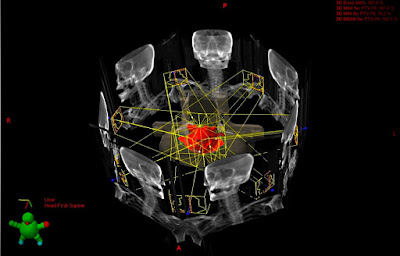
         3 Dimensional Conformal Radiotherapy (3D-CRT): RT delivered by conforming Radiation dose around tumor. Spares some normal tissue
         Intensity Modulated Radiotherapy (IMRT): A Highly developed form of 3DCRT, in which the radiation dose is tightly conformed around tumor. Spares most normal tissue.
         Image Guided Radiotherapy (IGRT): IMRT delivered in conjunction with a daily CT scan of patient done by the treatment machine. Used to account for changes in size of tumor and accurately adjust for variations in normal tissues.  


         Spatial Co-operation - 'The Steel Paradigm'
         Scenario where full strength CT & RT act independently, with Non-overlapping Toxicity Profiles
         Ideally, RT (Local Control) + CT (Systemic Control) = Improved outcomes
         Few CT agents meet this criteria due to - Limited Single agent activity + Toxicity driven dose reductions


 http://oncocare.in/workshop.html


         In Field Co-operation

         Scenario where CT & RT act together to increase Tumor cell kill.
         Full Dose RT (Local Control) + Reduced Dose CT (Enhances RT effect + Cytotoxic Effect) = Improved outcomes
         Strictly, Radiosensitizer - Enhances RT effect ONLY (e.g. Misonidazole)
         Low Dose CT - Radiosensitizer + Cytotoxic effect
         If Antagonistic action, then Radioprotective

radiologist in india


         Brain Tumors - Maximal safe resection followed by Adjuvant RT
         Recommended for all WHO Grade II/III/IV tumors.
         Head & Neck - Organ Preservation Approach
         Nasal Cavity + ParaNasal Sinus: Adjuvant RT for close/positive margins, PeriNeural Invasion (PNS - Adenoid Cystic Histology). Adjuvant CCRT for Lymph Node +ve
         Oral Cavity Cancers - Adjuvant RT for Close Margins, Stage III/IV, Lymphovascular/ PeriNeural Invasion +ve, Oral Cavity Ca with Level IV/V Lymph Node +ve. Adjuvant CCRT for Margins +ve, Extracapsular spread +ve.
         Oropharynx, Larynx, Hypopharynx - Upfront surgery not preferred. If performed, Indications remain the same as for Oral Cavity Ca. Additional Indications for Adjuvant RT - pN2-N3, Cartilage Invasion (+ Greater than 1 cm subglottic invasion - Larynx only)
         Salivary Glands - Adjuvant RT for Close/ positive margins, Intermediate-High Grade, Adenoid Cystic Histology, LVI/ PNI, T3-T4, LN +ve
         Medullary Carcinoma Thyroid: Adjuvant RT for Positive margins, Extensive LN +ve, T4a.
         Lung Cancer - All patients should receive Adjuvant treatment
         NSCLC - Resectable stage I/II: Adjuvant RT for Close (<5 mm)/ Positive Margins. 

         GI Cancers
1.    Esophagus: Resectable Node -ve (Non-Cervical). Unfavorable T2N0, T3/T4, N+ve or Close/Positive margins - Adjuvant CCRT (RT + Cisplatin/5-FU)
2.    Stomach: Resectable Node +/ -ve. Adjuvant CCRT (Mc Donald's - RT + Leucovorin/5-FU).
3.    Pancreas: Resectable. Adjuvant treatment controversial. Adjuvant Chemo (Gemcitabine) followed by CCRT (RT + 5-FU) - suggested
4.    GB: Resectable T1b or advanced. Adjuvant CCRT (RT + 5-FU)
5.    Biliary Tract (Intra/ Extra - hepatic): Resectable with Residual disease. Adjuvant CCRT (RT + 5-FU - Stereotactic RT preferred)
6.    Colo-Rectal: Resectable Stage I - Adjuvant CCRT for T2(RT + 5-FU). Stage II/III - Chemo(5-FU) followed by CCRT(RT + 5-FU) followed by Chemo(5-FU) vs NeoAdjuvant CCRT (RT + 5-FU) followed by surgery followed by Chemo (5-FU) 
7.    Anal: Resectable T1-T2, Node -, Close or positive margins. Adjuvant CCRT (RT + 5-FU/ Mitomycin)

         Breast - RT is an integral part of Breast Conserving Treatment (BCT). Even patients undergoing Mastectomy need Post Mastectomy RT (PMRT).
         In situ disease: BCT for DCIS
         Early Stage (I-IIB +/- T3N0): BCT vs Total Mastectomy + PMRT for T3/T4, positive margins, extracapsular spread and 4 or more Axillary nodes.
·         For T1-T2, 1-3 Axillary nodes: Consider PMRT for 20% or more positive nodes, size, margins, LVI, Age, Grade
·         For T1-T2, N0: Consider PMRT for Close/positive margin, Age, LVI, Grade
         Locally advanced: Chemo followed by Surgery. Mastectomy or BCT

         Genitourinary Cancers

         Bladder - Non Muscle Invasive: Adjuvant RT for Abnormal Cytology, Multifocal Disease, High Grade histology, Subtotal Resection
         Prostate - Adjuvant RT for Margins +, Residual disease on Imaging/Biopsy or pT3 disease
         Urethral - NeoAdjuvant RT for Distal Lesions or Lesions involving the entire urethra
         Testicular - Seminoma (Limited to Testis): Adjuvant RT
         Penis - Organ Preservation Approach - Increasingly favored based on Anal & Vulvar Ca results. Adjuvant RT for Node +

The indications for Definitive Radiotherapy/CCRT are numerous and continue to increase with ongoing Research.
Palliative Radiotherapy is an effective method of controlling some of the most distressing symptoms due to metastatic disease (irrespective of Primary).

Call us for More Details: +91 9811996326


Visit: oncocare.in